Friday, April 02, 2010

Whoa!! We Hate Persib and We Hate Persib!! We are the Persib...Haters.

Over a week ago, soccer came to Senayan once again in the form of an Indonesian Super League game between Persija Jakarta and Persib Bandung. This fixture is a grudge match to rival Liverpool versus Manchester United or Barcelona versus Real Madrid and, as a consequence of this, as well as the fact that violence has been endemic at Indonesian soccer matches over the years, all away supporters were banned from attending the game. The last time these two sides met in January however, there were no supporters watching at all owing to security concerns.


And so I peddled my bicycle to Senayan, locked it against a fence and strolled into the stadium grounds, trusting that nobody would mistake my scrawny white buns for those of a Bandung supporter and kick my head in. I don't generally have the greatest faith in the Indonesian police, even the 2000 strong force that were on duty at the match, and so I bought an orange scarf to show my allegiance to the home team. Orange is the Persija color of course and the city is turned into a riot of vividly adorned buses on match days. The team itself plays in red however. Go figure.

I made it to the VIP entrance and, after paying Rp.100,000 to a tout for a Rp.60,000 ticket, I managed to find a comfortable seat in the press area away from the unwashed orange herd. The person who dubbed soccer, "The beautiful game" had clearly never attended an Indonesian fixture. The national team has a pretty abysmal record of course and has just spectacularly failed to qualify for the 2011 Asian Cup and also recently lost to regional minnows Laos in the SEA Games. Possibly, things haven't been helped by the fact that the head of the Indonesian Football Association (PSSI), Nurdin Halid, ran the organization from a jail cell for over a year a little while back. Only in Indonesia, etc etc. I think the most hilarious story that I've ever read about the nefarious world of Indonesian soccer however involved a referee being chased around the pitch by a local Regent after a particularly controversial decision.


The Indonesian Super League itself is hardly overflowing with precocious footballing genius and most of its best players have been imported from Africa and various other countries. The atmosphere on the terraces was quite electric however. Bung Karno Stadium could do with a bit of renovating but can hold an impressive 100,000 people. The top tier had been closed off for the match but there must have been a good 50,000 present, all shouting, screaming, chanting, lighting flares, taking part in Mexican waves and most likely stealing each others’ wallets. Perhaps it says something about the Indonesian economy that a normal league game held on a weekday during working hours can attract so many supporters.

Eventually, the teams took to the pitch and battle commenced. Alas, the first half proved to be a somewhat enervating affair and the score remained 0-0 as we headed into the break. Things perked up considerably in the second half though and Persija scored a thrilling last gasp equalizer to draw the game 2-2. The referee even managed to award Bandung a penalty without being taken out by a sniper in the stands. The fans went wild and let off so many orange flares that the stadium started to resemble downtown Beirut.


Still, at least Jakarta hadn't lost and thus the chances of my being knifed in the kidneys had dropped precipitously. Now came the tricky part though, going home. I headed out and walked cautiously around the stadium’s perimeter as an orange tsunami spilled out of the various exits. I unlocked my bicycle and headed out towards the main road. Thankfully no one seemed to think it necessary to push me off and steal my mobile phone. In fact, most were content to simply point and laugh at me, it's not every day that you see a big nosed Westerner wearing a Persija scarf and riding a bicycle after all.

A few days later, I came across a story in this very paper which confirmed that my fears had been well founded. Apparently, a supporter had died after the match after being mobbed to death. Again, only in Indonesia it seems could someone be killed at a game at which there aren't even any away supporters. Apparently, a thug in the crowd had pointed to a small group believing them to be Bandung fans and him and his friends had then attacked them, killing one of them and putting another two into hospital. Of course, it later turned out that the victims had been Jakarta's supporters after all, funny that.

Alas, events such as this represent the negative flipside of the Indonesian psyche and its friendly sociability, the flipside of an intense neighborliness that transcends self conscious awareness. Mob formation and the propensity to run 'amok' (tellingly, one of the only Indonesian words to make it into the English language) are the dark underbelly of Indonesian society and its repressions. I imagine that these guys would struggle to later recall actually killing someone at the height of the mob’s unconscious, emotionally charged intensity and to explain why, when their man was already down, they kept on kicking. The reason could be that the collective drive of the mob, in psychoanalytic terms, eliminates each individual member’s higher functions of self-criticism and conscience.


Perhaps the attackers were taking a leaf out of the Bill Shankly book of life. Bill was the former Liverpool manager who famously once said, "Some people think football is a matter of life and death. I assure you, it's much more serious than that." Anyway, roll on the World Cup I say. My brave English boys will show these Indonesian whippersnappers what real hooliganism is all about.


Saturday, March 27, 2010

Roooooooooooxanne!!

Recently, a friend of mine suggested an evening’s R&D mission to possibly the dodgiest area of Jakarta. I am referring to Kalijodo, a street full of bar/brothels that lies next to the less than crystalline waters of the Grogol River just under the airport toll road in West Jakarta. The notorious Kalijodo red light district has apparently existed for about 300 years and some of its more wizened residents look as if they've been around for a significant proportion of that time.


Anyway, on Tuesday evening, the three of us parked up a side street close by to the 100 or so not exactly club class Bintang, baso and bonking joints that line the main Kalijodo strip. We soon found ourselves enjoying the fragrant ammonia fragrance of the river air as we promenaded past the endless parade of neon lit Bintang signs and locals trying to beckon us into tiny discos resembling Guatemalan prison cells, all blasting out 1000 watts of Dangdut classics. Surely a romantic ambience to rival Paris in the spring.

"Looking lady Mr?" came the persistent refrain however I think I can speak for all three of us when I say that the Guantanamo Bay atmosphere of many of these shantytown dance floors proved to be something of a passion killer. Many of these places look as if you'd need to wipe your feet on the way out. 


The general dilapidation and desperation of the area was palpable and we soon sought refuge in what appeared to be the highest class joint in the area, the sizeable Intan Executive Club. We stepped across the threshold and our eyes adjusted to the near pitch black interior. Many clubs in Jakarta seem to be enamored of the darkened movie theatre approach to interior design. Perhaps it’s all part of an energy-saving push for a greener, more ecologically sustainable prostitution industry or maybe every watt saved on lighting can be channeled mercilessly into the earsplitting PA systems, which will have you curling up into a foetal position if you're foolish enough to select a table close to the speakers. Most likely though, the darkness of these places provides a reassuring cloak of anonymity for the gentleman punters whose significant other halves wouldn't be too pleased if they knew where their hubbies were.

On our Tuesday night mission however, we were the only ‘executives’ in attendance and thus we were given the royal treatment. Every single person in the building it seemed (including around 20 girls) was paraded past us and shook our hands. The Intan was clearly a cut above the other horny truck driver haunts that we'd seen earlier and the not quite Vegas-esque cabaret at least made us young executives feel as if we were on more familiar Jakarta nightlife territory.

Mind you, maybe all is class snobbery. This may have represented the cheaper end of the spectrum but, in fact, Jakarta is saturated with prostitution and there are places to suit all income brackets, even five-star hotels. Kalijodo itself exists in a sort of corrupt legal grey area, despite various efforts to shut it down, as do many of the city's cat houses, spas and naughty karaoke joints.

Prostitution itself is legal in some parts of the world and illegal in others and even feminists don't agree on this topic. Those in favour of legalisation say that in a free society, making the world's oldest trade illegal violates basic rights and individual liberties. Obviously it's a crime to force somebody into such activity however, if you sell your body of your own volition, then that is your right. There's also the pragmatic argument that legalisation protects women from disease and violence as they can be monitored and helped. In New York, apparently close to 60% of streetwalkers carry the AIDS virus whereas in Nevada, where there is a legalised free market in prostitution, AIDS barely registers. At a deeper, more philosophical level, author Angela Carter posits an oft heard argument reflecting wider economic power in our society thus, "What is marriage but prostitution to one man instead of many?"


Opponents of prostitution say that it commodifies women as sex objects, leads to violence against them and is a consequence of male domination. I guess that I'd say that, for better or worse, the flesh trade is ineradicable and will always be with us, whether legal or illegal, a direct consequence of the fact that human beings possess a mix of genes typical to both monogamous and non-monogamous species. Schopenhauer once said, "There are 80,000 prostitutes in London alone and what are they, if not bloody sacrifices on the altar of monogamy?"

You'll never get rid of Jakarta's night butterflies, that’s for sure, as the seedy boulevards of Kalijodo testify. You’d have more chance of enjoying a night of passion with Herr Ratzinger (actually... scratch that). If you're going to criminalize hooking though, then at least bust the men as well as (or even instead of) the girls. It's always the ladies who are victimized here, as with the case of the sexy dancers in Bandung who were recently prosecuted. There's a certain strain of misogyny in Indonesian society that is unfortunately dovetailing with the increasing Islamification of the country at the moment.

I know a girl who was once in a group rounded up by the police for the crime of being in a disco. She was sent to a so-called, "Re-education," Centre in East Jakarta (it was a prison) in order to learn sewing (great). Encouragingly though, she managed to escape after three months by climbing out of a second-floor window and jumping down off a 10 foot wall to freedom. Girl power at its best.

Saturday, March 20, 2010

Livin' on a Prayer


Last weekend, I went off in search of answers. Usually its questions of a trivial nature that keep me awake at night, questions such as: Why is there only one monopolies commission? Is there another word for synonym? Or, if one synchronised swimmer drowns, do they all have to drown? This time however, matters of a less trivial nature were vexing me and so I decided to turn to God (well, one of them, the Christian one in fact).

Now Christians often have a rough time around this neck of the woods. Over in Malaysia, they have recently come under fire (quite literally) for their use of the word 'Allah'. Meanwhile, closer to home, bigotry and the mob mentality often predominates over pluralism and Indonesian churches are often blockaded and denied permits. Most recently, over in Bekasi, Muslim residents closed a local church after complaining that it was disturbing their sleep, which I must say I found ironic to say the least.

Christians are, as a result of all these shenanigans, often to be found hiding in churches located deep within shopping plazas and commercial estates in Jakarta. These are not perhaps ideal locations, given Jesus's attitude to the money changers and the like but perhaps, on another level, entirely fitting if you subscribe to the opium of the masses argument (and aren't shopping plazas our new churches after all?)


And so, last Sunday, I decided to pop along to one of these retail houses of worship to see what goes on and to do a bit of clapping. I soon found myself down at the Bellagio Plaza in the Mega Kuningan area, where the Jakarta City Blessing Church sits on the top floor.

I strolled inside the hypermodern house of the Lord and passed a door marked, ‘Sunday School’, which immediately gave me a flashback to the many tedious Sunday mornings of my youth. I shuddered and headed on into the Church proper. Inside, a mix of ethnic Chinese and ethnic Indonesians were gathered waiting patiently for the service to begin.


The mall church's interior was fully carpeted and crammed with plasma TV screens. A four piece electric band sat in the corner, ready to rock out below a painted ceiling mural of fluffy white clouds and infinite blue skies, which looked something like the Sistine Chapel done by Walt Disney. Basically, it was the complete antithesis of the cold pews and dour piety of the old British churches of my childhood and, I guess, more redolent of the American mega church phenomenon.

As if to confirm my USA for Jesus thesis, the female pastor stepped up to the altar, the band burst into life and the congregation leapt to its feet, ready to bellow out a Bon Jovi-esque soft rock power hymn. Rather than hymn books, the worshippers followed the words karaoke style on the church’s TV screens. It was all a very long way from, "Abide with Me" wavering out over creaking organ pipes.


The pastor skilfully worked up through the gears and into a religious semi-frenzy as she implored the congregation to pray for people from, "Pulau Nias all the way to Pulau Roti." Many of the congregation had their eyes closed by this point and their palms held forward, as if warming themselves in the Lord’s divine light. Yes, it was all very American of course, although the assembled parishioners stopped short of speaking in tongues and going all wobbly before falling over backwards.

Eventually it was time for the collection, however instead of the collection plate, envelopes were distributed with a handy BCA account number printed on them, should one wish to make a convenient transfer or set up a monthly debit payment. There was no Oral Roberts style hard sell though and we weren't threatened with being cast into a flaming lake of boiling excrement for all eternity. My envelope remained empty alas (I'm holding it now in fact) and I headed back out into the Bellagio with a view to consecrating a large curry brunch (praise him).


"God is dead," so said Mr. Nietzsche back in the 19th-century. Well, he certainly seemed to be alive down at the Jakarta City Blessing Church. What Mr. N. meant by this bold assertion though, is not that there aren’t people who still claim to believe. Rather, he meant that this belief is simply not of the type that people used to have. It is not the central pillar of our lives any more, as much as some of us might want to insist that it is. Our materialistic culture and our scientific rationalism have riddled such faith with the bullet holes of doubt and reduced it to a compartmentalised Sunday morning social club, after which the congregation retreats to the car park in order to compare their new cars (you should never try and keep up with the neighbours, by the way; as the great Quentin Crisp once said, it's better to drag them down to your level, it's much cheaper).


At the other end of the religious spectrum of course lies the Muslim suicide bomber. Are they any surer of their faith however? Perhaps, instead of rabid certainty, they are in fact trying to draw a line under their own unconscious doubts with a final, ultimate act of affirmation.

So where does that leave us? Ho hum. Well, I guess it's another week of existential dread and nihilism for me then. Happy Easter.

Saturday, March 13, 2010

2,4,6,8, Motorway

Last Sunday, I lurched awake nauseously at around 9.30, had a good cough and then reached for the mobile phone to see what drunkenly incoherent texts had been left for me in the middle of the night by friends, colleagues and lawyers wishing to serve me with writs. I sat up, narrowly avoided being sick on one of my handsome Rp.25,000 sarongs, and opened a message from my friend Dan (who likes to be known by his initials DPQ).

DPQ has only been in the country for just over a year and yet, a keen climber, he's already conquered many of Indonesia's highest peaks (when he's not out on the drink trying to conquer some of Indonesia's most flighty women). In conjunction with a friend, DPQ has set up a website which you'll find at: www.gunungbagging.com. 'Bagging' is British slang for collecting and the site features a wealth of information and scenic photographs of what he calls 'Ribus', namely mountains with at least a 1000m elevation drop all around.

Anyway, DPQ invited me to accompany him on a jaunt down to the Cicurug area of West Java, a town not far from Bogor. From there we would hike up to Kawah Ratu, a sulphurous crater around halfway up the 2211m Gunung Salak.  I'd be doing the driving of course.


And so, around an hour later, DPQ rocked up my house in his hiking boots, carrying a plastic bag full of bottled mineral water and cans of beer, I don't know why he bothered with the water to be frank as you can't beat shot-gunning a few tins of ale as you enjoy the natural splendor of a good mountain hike and I believe all of the best hiking safety manuals recommend such an approach.


My antique motor vehicle started on only the second attempt and we soon hit the southern ring road. I almost missed the Bogor turnoff for about the seventh time in a row owing to a combination of me fiddling with the EQ settings on the car stereo as we both enjoyed the sensational sounds of our favorite 70s German rock group, Can, and the fact that signs on the toll road are slightly erratic. There are in fact signs for Bogor all the way up to the penultimate set of signs.  On the final set of signs the word Bogor is mysteriously absent.


After swerving into the correct lane at the last second, we relaxed and enjoyed the half-hour run down to the end of the toll road at Ciawi.  The going then becomes a bit trickier and the road takes on more of an impoverished, banana republic character.  As if to underline this fact, a public minivan in front of us had one of its tires explode on it about 30 seconds after we left the end of the toll road.  The sexy racing wheels and 2mm thick tyres that the driver had had fitted to his Formula One wannabe probably didn't help in this regard.


Thankfully though, the insidious tentacles of the all-purpose mini-mart have spread out of Jakarta and seemingly all over West Java and thus we could stock up on water, chocolate, beer and prophylactics at 500m intervals. Eventually we reached Cicurug, a small town famous primarily for its 24 hour gridlock of public minivans whose sole aim, given the fact that 90% of them are empty, is seemingly to serve as a blood pressure increasing reality check for Jakarta motorists attempting to get out into the countryside for a break. “Think you've escaped Jakarta?” they seem to say, “Well think again matey, you're going nowhere... very slowly.”

Eventually we turned right and drove up the extraordinarily steep 12km road to the start of the hike, trying hard not to overheat the engine, plunge off the road down a ravine or otherwise flatten half blind octogenarian women carrying bundles of firewood on their heads.  Alas, when we reached the cool climate and pine forests of the national park entrance, the classic ill fitting uniforms of the Indonesian man in charge shambled towards us and informed us that the mountain was closed.
DPQ was not happy I can tell you. “You've closed nature?” he exclaimed, apoplectic with thwarted-when-trying-to-do-something-in-Indonesia fury. “Yes sir, I'm sorry, the park is closed until the end of the month, there may be a landslide and there's poisonous gas up there and...erm... it's slippery.”“Slippery!? Of course it's slippery! I'll take the risk thanks and I believe it is my risk to take if I want.” “But Misterrrr, people have died up there.”


This is true of course, I must have read any number of stories in the paper over the years about Indonesian students who've hiked up mountains in their flip-flops with bottles of Red Bull only to come a cropper when they realize that it gets a bit chilly and treacherous up there.

And so alas we were restricted to having a little walk around the forest area near the entrance.  It was a far cry from my knee straining assault on the 3000m Gunung Gede last year but there was nothing we could do about that. I was after a nice, relaxing hike and didn't fancy trying to out run a pursuing phalanx of national park security guards all the way to the summit. And thus with heavy hearts we were forced to turn round and enter the toll road traffic jam Purgatory of the great Sunday evening return to town. Take a look at DPQ's website though, once the wet season’s over it’ll be every man for himself up there.

Saturday, March 06, 2010

Beers, Steers and Queers

I'll start this week with a personal plea to any policeman who may happen to have read last week's effort. I swear I had no idea that the copy of Windows 7 that I recently installed on my new Quadcore behemoth of a computational beast was on the wrong side of the law. I bought it with the best of intentions from a handsomely stocked disc shop in broad daylight and have the receipt to prove it. Anyway, I'm very sorry officer but if you really want to clamp down on illegal activities in Jakarta then frankly, if you've got enough yellow plastic "Police Line: Do Not Enter" tape then it would be far simpler to just run a ring of the stuff around the entire city.

Let us move on though. This week I wish to address the subject of booze. Whilst many of Indonesia's more outlying provinces are in the process of adopting Sharia style prohibition, Jakarta seems to have been drunkenly lurching in the other direction of late. A real drinking culture seems to have developed in recent years, especially amongst the young. Wine bars now dot the city and Kemang is now full of middle-class youngsters hitting the bottle as if it's going out of style. I decided to investigate.

Only last week, young Sinetron ingénue, Cinta Laura, could be found in this very newspaper discussing how, "JIS (Jakarta International School) kids like to go out on a Friday night in Kemang." it was time to check it out and seeing as I'm only 17 and a half I knew that I would blend in just fine.


My first stop was a new bar called Bremer which is apparently very popular with the new breed of young paraffin guzzlers. I’d hoped to catch sight of Miss Laura emitting a Margarita fuelled rainbow yawn into the bushes before assuring me that I was her best friend in the whole world but alas it wasn’t to be. Me and my companion headed down a narrow alleyway and found ourselves in a lovely beer garden packed with drinkers.


The place reminded me of a British beer garden in fact although with fewer opportunities to get glassed in the throat for looking at someone’s girlfriend. At the bar, one could purchase a metre of ale (even beer’s gone metric) which turned out to be not one of those long, thin chemistry lab tubes but a meter long wooden rack full of about ten beer glasses. Nobody appeared to be drunk and disorderly although the staff’s bottle openers were clearly being kept very busy. I ordered up a bottle of a beer I’d never heard of before and immediately regretted it. It was a new local brew called Kuda Putih (white horse) and was the cheapest in the bar at Rp.22,000. It seemed to have been knocked up from Anker dregs collected from half drunk glasses and possibly actual horses were involved in the brewing of this tipple. 


A while later we headed down the road to a new shop called Boxmart which has ingeniously cashed in on the youngsters who like to sit outside Jakarta’s many branches of Circle K drinking beer of an evening. Boxmart is basically a Circle K with chairs, tables and even a mini stand up bar outside. We sat down and were immediately accosted by eight year old beggars. Still, at least in Jakarta the beggars and the Circle K street drinkers are separated out into two distinct groups, in contrast to many formative experiences I’ve had in London. Here at least, dishevelled middle aged men don’t stagger up to you breathing alcohol fumes in your face before inquiring in a slurred voice, “Excuse me pal, could you spare us Rp.10,000? I need a new pair of Bintang…SHOES…sorry I mean shoes”.


So why is there this apparent polarisation between increasing puritanism and prohibition in the provinces on one hand and an increasing prevalence of folk in Jakarta getting completely steampigged at every available opportunity? It's a complex problem I'd guess. However, in one sense, perhaps these two opposing behaviours are reactions to the same cultural malaise. This is namely the sense that, to quote a piece of poetry from one of my favourite bands, "The car's on fire and nobody is at the wheel."

By this I mean that there's perhaps a general, either conscious or unconscious, understanding that the planet is sleepwalking towards oblivion and that our politicians, mired in incompetency, corruption and a growing totalitarianism (and also punch-ups in Jakarta this week) completely lack the moral authority and compass to renew a globe that is spiralling out of control. Nowhere can this feeling be more acute than in Indonesia I would wager. One reaction to this creeping collective paranoia is a misguided attempt to purge society of its perceived decadence and to revert to the strictures of religious dogmas. Thus ten years after winning their freedom, many Indonesians seek to once more emasculate themselves under the lashes of Sharia's whips.

Another reaction to the sense that no one's really in charge though is to fiddle while Rome burns, blot it all out and overdose on hedonism before a sobering future arrives. Bottoms up.

Thursday, February 25, 2010

I'm the Operator with My Pocket Calculator

Last week, I finally took the bull by the horns and lugged my battered desktop PC along to Ratu Plaza for a major upgrade. It's been about five years since I last attempted such a foolhardy act and in the meantime my once proud machine has become technically obsolete, left in the dust as our accelerating world of high-tech gizmos streaks off into the sunset.

I selected a new fancy pants  Intel Core 2 Quad processor and a new motherboard plus 4Gb of RAM, a 1 Terrabyte hard drive and a sexy new casing. I kept my old monitor, soundcard, keyboard, mouse, DVD burner and Internet WiFi dongle. The nice man in the shop slotted all of these old and new bits together within about half an hour and I then popped a few shops along to buy an illegal version of the new Windows 7 operating system.


The government and police pay lip service to stamping out the pirated software industry here of course but they are not trying very hard if you ask me. It's not as if these discs are just being sold out of suitcases on street corners by guys ready to run away at the first sign of trouble. I mean there are entire shops in well-known plazas full of racks of thousands of discs which have all dedicated their efforts towards making Bill Gates' nerdy spectacles steam up with incandescent fury. Old Bill got his revenge on me later though, oh yes.

And so I picked up a Windows 7 disc and headed home to test drive the new machine. I spurned a friend’s advice to try Ubuntu, the free operating system based on Linux, as I don't possess an anorak and have actually kissed a girl before (a real one too, not just a guy in a dress or something). So I decided to stick with good old corporate, monopolistic Microsoft.


At home however, events took an all too predictable turn and served to remind me exactly why I had resisted upgrading my machine for so long. The various hardware and software driver issues sent my blood pressure soaring through the roof as I spent hours and hours and hours searching for new drivers that Windows 7 would actually support and dealing with various issues and conflicts and the pain of reinstalling so many bits of software. 'Plug and Play' they call it. Boy did they get that one wrong. 'Plug and Cry', or 'Plug and Unplug and Bloody Well Plug Again' would be more accurate names. I'd advise Microsoft to drop the, 'and Play' part and just call it "Plug..." with three optimistic dots after it.

And so, paradoxically, I had tried installing Windows 7 in order to make life easier and ended up having a three-day mental meltdown. What's going on here? Trendy German philosopher from the 1960s, Herbert Marcuse, noted how our rational, enlightenment, science culture often ends up producing irrational outcomes such as this. People sit gridlocked in cars, going precisely nowhere fast in devices originally designed to make movement easier. Stock markets crash due to computers individually making decisions based on limited data and then clashing violently with each other when the bigger picture swims into focus. Mobile devices, far from freeing us, bind us ever more tightly into a shell of online existence from which there can be no escape.


For Marcuse, there is no historic, science driven path to enlightenment and rationality leading from slavery to freedom, only one that leads from the slingshot to the H-bomb.

Secondly, Marcuse also notes that science is now so complex and that we are so buried under oceans of data and bureaucracy that, paradoxically, people will believe any old rubbish about crystal healing or tofu in order to attempt to get a bit of clarity and order in their heads and so again, irrationality springs from rationality.

To these two formulations I think that I would add a third, namely that devices designed to make life less stressful and more pleasant and convenient end up irritating the bejesus out of me, not a very rational outcome. And it's not just Windows 7 that has made me contemplate an act of computer defenestration. Every time I enter a branch of Circle K or pull up to a car park barrier in town and trigger an automated, digitally disembodied voice which proceeds to regale me with chirpy, synthetic salutations, I want to cut somebody up with a chainsaw. Every time I phone up to complain about my Internet service and am confronted with an automated answering system, I go all sweaty and purple in the face after about four button push submenus. Every time my mobile phone cuts off in the middle of a conversation, I have to restrain myself from tossing the thing under the wheels of a passing bus.


Well folks, it's now a week later and I'm still having computer problems. I guess that I at least have the recourse to unplug the damn thing though. How long will it be before the computers decide to unplug us?


Saturday, February 20, 2010

Three Wheels on My Wagon

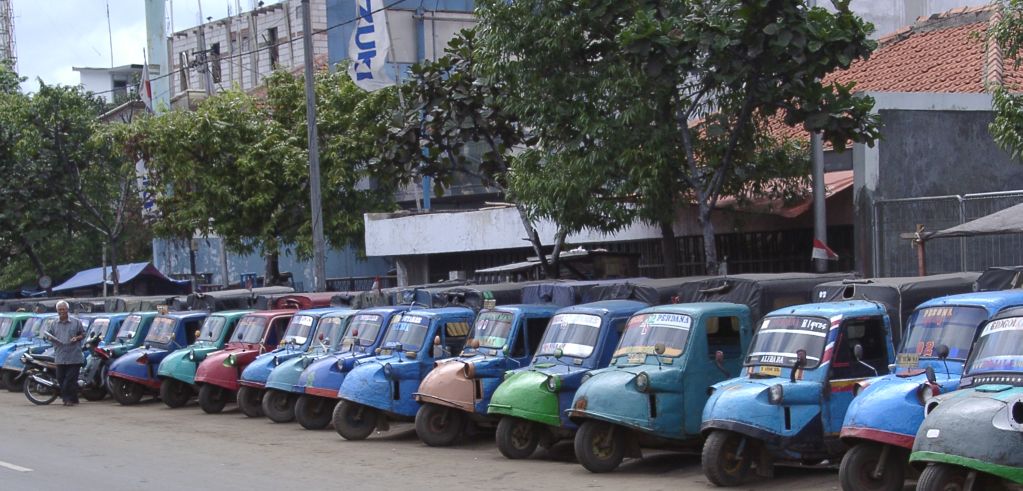
A story appeared in last week's Globe stating that the days of the bemo, those three wheeled minivans that look like elongated bajajs and which can seat about eight, are numbered.  The city administration plans to get rid of the 1000 bemos is still dragging their sorry arses around the city's thoroughfares by 2011. In fact though, bemos have actually been illegal in the capital since 1996 but, as with so much else that happens in this country, the connection between legality and what actually happens in reality is tenuous to say the least.


Anyway, I thought that I'd take a bemo ride for old times sake as, during my first year in Jakarta, I remember enjoying a few amusing trips in the pathetic little things.  And so I strolled down to the flyover that crosses Jl. Sudirman next to the Meridien hotel and found a waiting fleet of about ten bemos squatting on the road like abandoned dustbins after a street fight.  The lurid paint jobs could hardly disguise the fact that these battered three wheeled shopping trolleys fitted with sewing machine engines are now well over 40 years old.

It's quite amazing that these things are still running at all and riding in one, you have the nagging suspicion in the back of your mind that the floor is going to collapse and buckle underneath you, leaving you running frantically on the road below like Fred Flintstone out on a Sunday drive.


The very fact that these Paleolithic old bangers are still running at all however is something of a triumph of human ingenuity.  Jakarta's creaking bemos remind me of Cuba's time warp fleet of 50s American gas guzzlers.  As with Cuba, the bemo drivers and mechanics have made a virtue out of a necessity and continue to defy the capitalist logic of waste and planned obsolescence.

It seems almost magical that these things still start in the mornings.  I wonder how many miles they've clocked up over the years?  A quick Google search on vehicle longevity brings up a 1976 Mercedes-Benz 240D owned by Greorios Sachinidis from Greece. This particular vehicle has apparently notched up an amazing 2,858,307 miles, which is the distance to the moon and back about five times.  Some of Jakarta's bemos may also perhaps have made it to the lunar surface at least once.


The average lifespan of a motor vehicle these days is just 13.5  years and it's hard to imagine any of today's cars lasting for 40.  As the world begins to hit the barriers of resource limitations our consumer culture ironically follows a model of increasing disposability.  People simply don't know how to fix things these days, unlike our brave bemo mechanics, and in a way perhaps they can't.  Our advanced technologies are increasingly specialised and arcane. You can always weld a broken exhaust pipe back onto a bemo but how are you going to fix a faulty Intel microprocessor? With scissors and glue?

Technological progress follows its own inexorable logic however.  Free market capitalism means that production has to be constantly revolutionized if a company is to stay ahead of the competition.  You simply have to fund R&D and scientific research if you want to maintain your competitive edge.  Capital has thus engendered a hyper accelerated culture that has quite astonishingly propelled us from the horse and cart to the space shuttle in less than 200 years.

I'm not quite sure where exactly bemos fits in on this continuum although they are perhaps nearer to the shuttle than it may appear at first glance (and the things are probably equally likely to explode on you).

There can be no time for historical materialism when one is trying to catch a bemo however.  Last week's Globe intimated that most of the drivers of these vehicles were dodgy gangster types.  They certainly had a good old laugh yours truly as he waited for his chariot and also attempted to charge him Rp.10,000 for a Teh Botol (and offer him women to boot).


Eventually, it was time to hit the road and I elected to sit up front next to the driver as we chugged off towards Tanah Abang.  An alarming amount of fumes started to waft up into the cabin from around the sides of the gear stick, making me feel a little lightheaded.  Perhaps the powers that be want to squash the bemo due to its internal as opposed to its external pollution.  Certainly the little things are no dirtier, in terms of exhaust smoke, than the fleets of orange Metro Minis and green Kopajas that fart their merry way around Jakarta every day.

In fact, I've long thought the parlous condition of the capital's buses to be rather strange in light of the fact that most of the country's other towns and cities are served by gleaming new squadrons of Angkots (mini vans).  What's all that about then eh?


Eventually, we puttered to a halt in the heart of gangster land (downtown Tanah Abang) and I shelled out Rp.2500 for the privilege of traveling in a vehicle older than I am (twice as old in fact...ahem).  So what will become of these senile motorised tricycles and the army of rough diamonds that pilot them?  The lure of the ojeg surely beckons...