Monday, October 20, 2008

Let There Be Light


Well shiver me timbers! I recently had the opportunity to return to the high seas and once again steamed manfully out of Sunda Kelapa one salty Sunday morning. I'm getting a bit ahead of myself however. First things first. I had to traverse Jakarta by road in order to reach the city's deep and diabolically diseased briny.

The early Sunday morning Jakarta ambience is something I usually miss for reasons which are no doubt identical to your own lack of enthusiasm for the 7 a.m. that follows hard on the heels of a good rocking Saturday night. The city is at its daylight hours freshest on Sunday mornings though and as I drove uptown one could almost believe that one lived in a metropolis in which some semblance of order and restraint prevailed.

My taxi headed up through the quiet streets of south and central Jakarta on its way to the sea. Interestingly, someone had been tampering with the 'Tarif Bawah' (low fare) stickers on the back window of my cab. By discarding the 'B' in 'Bawah' and rearranging the remaining letters, some cheeky swine had made my taxi say 'Tarif Waah!'. Thankfully I don’t think it was the driver himself as his meter was ticking over at quite a sedate speed.

When we reached Jalan Thamrin we hit (not literally) the Sunday sporting types who, utterly lacking in exertion, cycle and jog down the centre of the road at about 1 km per hour. These people are clearly not in it for the exercise and I believe their sole motivation is to make the party animals that spill out of Kota's clubs and discos after pulling an all nighter feel even more exhausted and ill than they do already.

As I continued my cab journey I chanced upon the most delicious site up near Monas. Some of you may have read in the paper in recent months about Jakarta's new roller-skating police division. I had been initially skeptical about this, believing the story to be a hoax. Most of the policeman that I see on the streets seem a touch too portly to be attempting such a kamikaze feat.

There they were though, large as life, weaving in and out of the joggers and cyclists on their hot wheels like members of Village People. Weaving in and out of cars and motorcycles though may prove to be a more difficult undertaking.

After reaching the lovely Marina Batavia and setting sail with the good Captain Hans, it was time to put skating cops behind us and enjoy the turgid delights of Jakarta Bay once more. This time we were heading out to one of the nearest of the Thousand Islands, Pulau Damar Besar, alternatively known as Pulau Edam due to the fact that Jakarta's Dutch governor had a mansion here over a century ago.

The seas we encountered on our outward journey were, alas, disgustingly full of trash. At various points on the 15 km long trip a flotsam of instant noodle and detergent packets guided us towards the mounds of rubbish that piled up around the Pulau Edam jetty itself. It was all very depressing and one has to venture a lot further afield, deep into the Thousand Island chain in fact, before things become cleaner.

Despite the rubbish around the jetty, the island does have some fascinating points of interest. Most spectacularly, there's an old steel Dutch lighthouse, still in operation, which dates back to 1879. Myself and my fellow passengers were feeling game and so we scaled the spiral staircase up through the 12 levels to the round balcony that rings the top of the Lighthouse, just below the light itself. The view of the tiny island and the sea below from here was truly spectacular, if a little scary for those of a vertiginous disposition.

Also on Edam Island lies the ruins of the Dutch governor's mansion which can be found in the middle of the island's small wood. We trekked off to find it and were taken by the moody grandeur of the remaining roofless walls set against the dim light of the forest interior. The ghosts of the past seemed to be circling around us.

Jakarta's very own Mr. Moustache, Governor Bowo, should perhaps consider reviving this tradition and rebuilding a pad for himself and all of his little Bowos out here. A local TV station could start a new reality show called Governor's Island. They could assemble a small population on the island of, say, 20 Jakarta taxi drivers. It would then be the governor's task to provide them all with amenities and housing before they died. He would have to succeed in this task before we let him back loose on a capital city of 15 million people. If I approach SCTV with this idea they'll bite my bloody hand off I'm telling you. I wanna see that boy digging a latrine...

Sunday, October 12, 2008

Say It with Flowers


Thank the Lord that another holiday season has limped to a close in a colourful blaze of dangerously substandard fireworks, chilli sauce induced heartburn and 17 km long road tailbacks. If you returned to your home village, I hope you had a lovely time and managed to discourage your various relatives from returning with you to the Big Durian by informing them honestly that Jakarta's streets are not, in fact, paved with gold but something altogether browner and sludgier.

If you attempted to drive out of town for reasons other than that of filial duty then what the hell were you thinking? Actually, what the hell was I thinking when I agreed to accompany a friend on a drive up to Puncak on the Wednesday of Idul Fitri itself. The journey up into the hills wasn't too bad however and the drizzle only added to the delicious coolness and relief of reaching an altitude superior to the capital's warm fart ambience.

We were going to stay in one of Puncak's huge holiday villa complexes for a couple of days. The one we were staying in was called Kota Bunga (Flower City). After a nightcap or three and a hearty sleep I awoke and went for a stroll in order to familiarise myself with the Kota Bunga experience first hand in all of its prefabricated, garish hideousness.

The complex covers a huge area and is arranged into neat suburban cul-de-sacs of houses that are seemingly exactly the same as the full-time Jakarta pied-a-terres of the families who come to stay here. The only discernible difference would possibly be the vibrant hues of the houses’ exteriors and the postmodern mishmash of cutesy architectural designs that proliferate like a Walt Disney acid trip.

The Flower City seemed to be mainly populated by aspirational Chinese Indonesian families of a familiar type (just to delve into the unconscionable world of racial stereotypes for a moment here). Big Mercedes, Dad in a bright nylon T-shirt, Mum's hair extravagantly coiffured into a vertiginous gravity defying quiff and two Nintendo brained children having ice cream and noodles shovelled down their wide bore gullets by a Javanese girl in a nurses uniform.

Stereotypes don't always hold though. I was actually visiting the flower city with the Chinese Indonesian friend of my own and his girlfriend. He is in his 40s and as yet unmarried and so doesn't really fit into the charming family unit model depicted above. He does however usually try to avoid meeting these bi-ethnic nuclear families due to the endless enquiries as to why he hasn't got hitched yet that repeatedly punctuate the conversation like a skipping CD.

Strolling around Kota Bunga's yellow brick road type boulevards it became clear that any expression of West Javanese culture had been tastefully airbrushed from this theme park in search of a theme. Admittedly there was an area in the complex called Kampung Budaya (Cultural Village) although its cultural reach didn't seem to extend beyond an overpriced KFC and a swimming pool full of urinating kids.

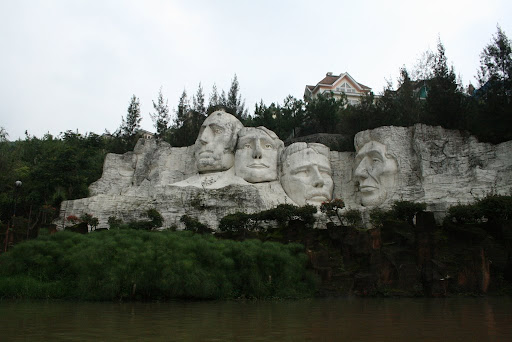
Further up the hill we came across the focal point of Flower City, a lake full of banana boats and a mini Mississippi steamer. Around the edge, a post-modern apocalypse of ersatz Greek friezes, old English lamp standards and mock European architecture all clashed in tasteless hyper reality, stripped of their original meanings and transplanted into this toy town fantasy. Pride of place though went to the scale mock up of Mount Rushmore that perplexingly loomed 30m high over the lake. The chiselled faces of the four US presidents surveyed the scene before them sternly as if about to pass judgement.

Later that evening we drove down the road to another Puncak mega villa complex, this one called Green Apple, where loud music blared over fake bright yellow castle turrets and battlements whilst hordes of Green Apple residents shopped for cheap T-shirts and high cholesterol snacks.

A more intense vision of hell I had never seen... until the next day that is when it was time to drive back to town. We got the timing wrong and ended up in traffic jam Armageddon as we descended down the hills. This must be what really happens in hell. You sit in a four-hour traffic jam, shouting imprecations at the dashboard, before reaching your fiery destination and burning for a few hours. You then stand up, dust yourself down, receive a new set of car keys from the Devil himself and start the whole process again.

I need a holiday.

Sunday, October 05, 2008

Ego, Superego, Eid.


Well, the holiday season is finally upon us and not a moment too soon. As the globe turns to fiscal custard before our eyes I think we could all do with a few days of laughing, feasting and well earned breaking before the coming decade-long depression.

Perhaps this timely coincidence of religious ritual and capitalist free market meltdown has been pre-ordained by God himself in his greatness. If one can interpret tsunamis and earthquakes as divinely ordained punishment then why can’t global financial crises also be congruent with the Lord’s anger? Maybe Allah's on my side after all and is signaling his displeasure at the values of greed, over consumption and general pursuit of wealth forgetting all but self that our money obsessed generation have internalized.

Yes, maybe the Lord above yearns for a more egalitarian society too. Certainly ideas of financial fairness and a disdain for interest on loans and usury can be found in the holy texts. However this notion, as with so many other ostensibly moral religious ideas and precepts, has been subsequently evacuated of meaning and turned into the hollow hypocrisy of the Sharia banking system under which interest is simply renamed and re-categorized as service charges and the like.

If God wishes a more socially responsible and equitable society though he'll be waiting until the second coming (actually I may be getting my religions mixed up here). This week saw far right Republican freaks voting against Bush's bailout package on the grounds that it represented the first step towards some kind of left wing, socialist nationalization program.

The reality surely is that the transfer of hundreds of billions of dollars of public money into the avaricious mitts of private financiers with very few preconditions attached will only serve to bolster the inherent instability of our so-called advanced free market, roulette wheel of a system.

If any good comes out of this whole sorry bailout debacle it will be the public finally seeing that the emperor is wearing no clothes, seeing that the way our banking system socializes debt and privatizes profit is supremely undemocratic.

It’s a system that has now failed and just maybe the champagne swigging financial speculators will become similar objects of public derision and hatred as commies were in the West during the last century.

Can new political movements emerge from the rubble though or is our society just too atomized and technologically sedated to get its collective sh*t together?

Enough of the banking sector though. As the Idul Fitri holiday draws to a close its time to reflect and meditate upon the good that life has brought us. And if some poor Pembantu (maid) toiling away in Jakarta for a pittance can squeeze herself through a 2 1/2 inch gap in a train window and suffer temperatures approaching that of the core of Venus for 15 hours as she slowly travels back to central Java to visit a family that she only gets to see once every six months and can give thanks for the experience then I think we can all be jolly grateful for our lot in life. "At least I haven't got a mortgage," she is probably thinking to herself.

But enough of the preachy sermonizing. Perhaps I should feel lucky…unfortunately I don't particularly. However, I am willing to give unbridled thanks to the creator for blessing me with the bottle of vodka that sits in front of me right now. Admittedly it didn't descend from the heavens and I had to go and purloin my magic Aqua from a shop in Kemang, but perhaps it was divine guidance that led me there.

Jakarta has been blissfully empty this Idul Fitri of course, as it is every year. I say blissfully although in fact it's not that much fun seeing as so much is closed.

The idea of the Mudik (annual exodus home) is an interesting one though. I already discussed the treadmill of fasting and gluttony that takes hold here during Ramadan a couple of weeks ago in MM. After reading my scabrous and potentially blasphemous analysis, a friend told me that, in fact, death rates rise here during Ramadan as the cycle of fasting and scoffing takes its toll on the old and weak.

That's nothing though compared with some of these marathon journeys back to home villages. Car pileups, marathon overloaded motor scooter journeys, train carriages so full that passengers can't even fight their way to the toilet during the 20 hour trip, buses plunging into ravines, airport cancellations. These are Homeric odysseys of stamina and endurance. It can be no surprise that, once home, these weary travelers can't face the return journey to Jakarta for up to a fortnight later.

Anyway, happy New Year everyone. I'm off to clean the kitchen myself, what with the maid gone, impressive huh?

Sunday, September 28, 2008

Metro vs. Metro


In the latest of an occasional series of columns about the parlous state of the city's transportation system, I thought that I'd venture out for a spin on one of the city's Metro Mini buses. You know the ones: those oddly shaped, orange guided missiles that steam around Jakarta's streets terrorizing and annoying other road users and pedestrians in equal measure.

Metro Minis, along with their green and white brothers, the Kopajas, are a familiar sight on the city's main arteries. I occasionally like to catch a Metro Mini for a 30 minute jaunt to Blok M for a shop which never fails to draw a few witticisms from the seemingly 14-year-old chain-smoking Konek (bus conductor) as he collects my fare.

The Metro Minis generally come in for a lot of stick from Jakarta's commuters. The drivers tend to block junctions and impede other road users by crawling at a snails pace around certain tight sections of road. The bus stops may as well not be there at all as your average Metro Mini will stop absolutely anywhere in search of that elusive extra passenger.

In their defense though, Metro Mini drivers and conductors not paid a salary and thus have to trawl for every single passenger they can get. If they were paid a wage like bus drivers in other countries then there would be no need for them to stop in the middle of junctions, provoking a fanfare of aggrieved car horns as they do so.

It would thus seem that the elites in charge are to blame. Their cheapskate approach to public services and amenities are once more in evidence here. If less money was skimmed off the top of the city budget then maybe we wouldn't have to put up with these loose cannons of mass transportation. I mean a coat of bright orange paint can't really hide the fact that these battered and bruised monsters belch lung scouring, eye stinging smoke into the environment and are so old they were probably left behind by the Japanese after World War II.

The issue of road safety is something else though and it is harder to excuse the MM drivers for tooling around like Lewis Hamilton after a heavy crack bender on purely financial grounds. They should perhaps go a bit easier on the Extra Joss and Krating Daeng energy drinks. Then again perhaps it's the cigarettes. Many drivers only need one match to start them off in the morning before a long day of chaining one cigarette off the other, punctuated by unpleasant expectorations of what we Brits call, "Dockers omelettes,” through the cab window.

Night-time brings its own Metro Mini hazards too as the powerful 2 Watt headlights and half a Watt taillights (which are obscured by thick black clouds of exhaust anyway) are switched on to full beam, turning the MMs into the invisible Stealth bombers of the streets.

All of this being the case, maybe it's safer to be inside a Metro Mini than outside of one. That's what I tell myself whenever I board one anyway. Today I jump on the bus and jam myself into a seat that gives me about 3 cm of space for my legs. The corrugated metal floor starts to heat up my feet and I settle into the full MM first class experience.

The city administration apparently wants to get petit bourgeois types out of their cars and onto public transportation. There's not much chance of that happening if the options are the overcrowded Busway or these old orange garbage cans on wheels. Class divisions are certain to continue to keep the moneyed off public transportation (that and the lack of air conditioning).

It's not impossible though to get middle-class people to give up driving into town if there's a viable working alternative. To take an example I'm familiar with, if you were to step on a London Tube train late in the evening the first thing that would strike you (apart from the appalling smell of stale urine perhaps) would be the amount of ‘posh’ people traveling home.

Back on our MM, a busker clambers on board with his Rp.50,000 acoustic guitar. The type it's impossible to tune properly. The metal strings cut into our busker's calloused fingers like cheese wire as he begins to sing. The voice isn't too bad although the mechanical limitations of his instrument begin to pall after a while.

Soon after this, the hawkers begin to board the bus with their cornucopia of knickknacks: pens, lighters, water and seven-week old squares of tofu. It's not much of a way to make a living and most of them traipse through the bus and straight out the back door like lemmings, hardly even stopping to see if anyone actually wants to buy their tat.

Eventually my stop arrives. Although it’s not much of a stop really as I, like most of my fellow Metro Mini passengers, are forced to leap kamikaze style into the traffic whilst the thing is still moving.... and there are people who laugh at me for riding a bicycle around Jakarta.

Sunday, September 21, 2008

Allaaaaaaaah's Snack Bar


Idul Fitri's coming, the geese are getting fat. Well maybe not the geese perhaps but the population in general almost certainly. It's long been a fact of life in Jakarta that during the, "fasting," month, more food is consumed than at any other time of the year.

Far from Ramadan being a time to distance oneself from corporeal appetites and focus one's thoughts on the divine, the holy month in Jakarta is a time of inflation, unexpected traffic jams at odd times and, above all, heroic feats of fast breaking gluttony.

Stroll into any shopping mall food court just after 6 p.m. and you could be mistaken for thinking that you blundered into some crazed Coney Island hotdog eating contest only with the dogs replaced by fried rice and the time-honored charms of the Baso ball.

If you can find anything left to chow down on you'll then have the challenge of finding somewhere to sit among the assembled Sambal-oholics. The gustation continues in earnest into the wee small hours as hungry followers of the world's fastest-growing faith try and shovel in an amount of carbohydrates that would have top Olympian Michael Phelps reaching from the Pepsobismol.

Why the calorie levels go off the scale to the extent that they do during the fasting month is anyone's guess. Perhaps it's like Catholic schoolboys and self abuse. The prohibition only makes them want to do it more.

After the bull seals have gorged and built up reserves of fat that should see them through a hard winter's sitting in traffic, it's off home to watch a few Sinetron soap operas in which the usual philanderers and white-collar criminals are now suddenly seen sporting religious garb, a pious overlay that only serves to add a layer of deviousness to their skullduggery.

Fasting and then gorging like this leave a bad taste in the mouth (that’ll be the Baso) in a country where malnutrition still runs rife. Many in far flung provinces don't have the option of the 6 p.m. bloat out and sleep on empty stomachs, regardless of their religion.

Of course there is the Muslim tradition of giving alms to the poor during Ramadan but you sometimes wonder who extracts the most benefit out of this, the poor receiving their paltry kilo of rice or the rich whose consciences are salved by such annual displays of extremely modest largesse.

Certainly the poor of East Java didn't fare very well this week, 21 of them dying in a stampede of thousands as they try to get their calloused mittens on a miserable Rp.40,000.

Of course from the perspective of an infidel atheist (who is kind to small animals I might add) science is an important lens through which to view the strangeness of religious rituals such as fasting. Evolutionary biology and anthropology tell us that the ascetic rigor and exclusivity of the world's three main monotheisms originated in one of the world's harshest environments (outside of the Arctic Circle). Conversely, more fertile, tropical areas of the planet tend to give rise to more inclusive, laid-back polytheistic religions.

This can be no coincidence surely. Indonesia's easy-going Epicurean fertility tends to the latter but has had the strictness of the former overlaid over the top as an inflexible moral template in recent centuries. The harsh mindset of the desert doesn't come easily here and it's perhaps this mismatch between intention and desire that has led to the country's delusional, dishonest and corrupt social and political culture.

But that's enough theorizing for now. Actually thinking again about the Arctic Circle, it's amazing that the Eskimos didn't come up with something even more totalitarian than our desert influenced monotheisms. Those icy winds should surely have put some steely zeal in their hearts. I guess the fasting would be a problem though if there were six months of daylight at a time. A crash diet like that could have serious consequences although possibly the rotund Gus Dur would still be going strong when the sun finally set after half a year.

Thankfully this year the FPI (Islamic Popular Front) have again been quiet and have refrained from smashing up bars with big sticks. The FPI’s blinkered and childishly reductive interpretations of their religion are clearly a treasonous insult to the traditions of scholarship and debate that lie at Islam's birth.

Unfortunately though the pornography bill, a draconian piece of legislation designed to stop people kissing their wives in public or wearing skimpy outfits, looks set to be passed during the next week as, and I quote,” A Ramadan gift," to the people. Indonesia's politicians certainly know all about gifts that's for sure, although usually they are the kind given in brown envelopes. On the bright side though, I'm looking forward to mass bikini clad anti porn bill protests in the New Year. The Jakarta Post this week summed up the whole controversy brilliantly with a perhaps unintentionally punning headline that read," Resistance Mounts Against Porn Bill". Happy Christmas.

Sunday, September 14, 2008

Fart of Darkness


I was recently lucky enough to be able to put some distance between myself and Jakarta's boggy boulevards. Leaving “Dry” land behind, I ventured out onto the high seas for a day's drinking bourbon on deck in the hot sun whilst turning a virulent shade of lobster pink.

Traditionally, the city's bourgeois weekend yachtsmen have moored their fabulously expensive toys at Ancol Marina. However, a few months ago, the new Batavia Marina opened the business just next to the traditional cargo docks at Sunda Kelapa in the north of town. This new Marina boasts a pristine new building which contains a bar, a restaurant, a billiards room and a full conference hall. The contrast between this glittering high-class clubhouse and the ragged trousered, weather-beaten old coves with dental work like burnt out villages who unload the battered old ships next door couldn't be more marked but that's Jakarta to a tee I guess. The perennial highlife-lowlife contrast.

My friend the captain, the good Mr Hans, is a long-time German expatriate. With a beard full of barnacles and many years of sailing experience behind him Mr. Hans had some amazing yarns on the subject of piracy on the ocean wave which he spun with great enthusiasm as we skipped across the diamond sea.

In fact though, the sea wasn't actually very diamond like until we were well out of Jakarta Bay. The two or three km of ocean closest to the shore aren’t so much diamond as diarrhoea. It never ceases to amaze me when I see kids swimming through the sludge at Ancol beach whilst a Chernobyl-esque power station belches industrial waste in the middle distance and estuaries of turds spill out into the open sewer of the sea. Er.. I'm sorry; I hope I haven't put you off your Sunday lunch.

Rather optimistically, one of our number elected to come on the boat with his fishing rod. His line baited with finest supermarket squid, he cast his line into the sludgy industrial toxins of Jakarta Bay as we headed further out. Funnily enough he caught nothing whatsoever during the entire trip although I guess there was always an outside chance of snagging a six-foot long radioactive mutant with two heads and four tails.

The fish weren't biting however and so I turned to our sea captain for entertainment and a few tales of yore. He confirmed that navigating the waters around Indonesia could often be a risky business due to the large number of nefarious nautical types ready to pounce at the first available opportunity.

Indonesia's seas, some of the most pirate ridden on the planet, hit the news a decade ago during the financial crisis when economic hardship caused crime on the ocean wave to rocket. Various tales of cruise ships held to ransom by desperate local fishermen and the like surfaced at the time.

Captain Hans assured me that piracy in Indonesian waters has decreased somewhat since those desperate days but that there are still plenty of Jolly Roger hoisters out there ready to chance their arm. Sailors consequently need to keep their wits about them at all times even though pirates in this country are much less likely to have guns on them than their peers in the Philippines.

There are various danger signs to watch out for apparently including boats some distance off that appear to be moving parallel to your own. This technique is used by pirates to try and match and gauge their target’s speed before attacking. Also sailors should beware if there's no one on the deck of a nearby ship ready to exchange a friendly wave.

Our captain has apparently had various narrow escapes in his time. He once had to smash his way through a ring of smaller boats surrounding him. Another time he had to emerge from below deck screaming like a banshee with a large kitchen knife in his hand in order to scare off some would-be attackers. On another occasion he saw off a suspicious boat by brandishing a length of tubing as if it was a rifle which evidently, at the distance they were at, fooled these would-be assailants into thinking twice about assailing the good captain’s vessel.

I was starting to feel a trifle nervous after all these stories. Eventually we moored off the coast of one of the nearest of the Pulau Seribu (Thousand Islands) and swam through the clearer waters onto the tiny island.

About 30 local Jakartans were packing up ready to depart as we arrived. They had been enjoying their annual day trip out to the Thousand Islands although seemingly hadn't found any buried treasure. For them it was enough to have a nice swim in some clear water without catching some interesting new skin disease presumably.

They soon set sail in their overcrowded, creaky old wooden crate of a vessel; its filthy, spluttering superannuated outboard motor shattering the peace for miles around. Pretty much the oceangoing equivalent of one of Jakarta's orange Metro Mini buses. And good luck to them too. Bloody 60 foot long luxury catamarans draped with bikini clad lovelies. Who needs ‘em?

Sunday, September 07, 2008

Stairway to Heaven


The Bali bombers’ saga is currently limping onwards towards it squalid and inevitable conclusion. A hail of bullets should soon be offloaded at its three unrepentant protagonists, after a final trio of Gudang Garam cigarettes I shouldn’t wonder. Amrozi, Imam Samudra and Ali Gufron have been tying themselves in logical knots in recent weeks, protesting the death penalty one moment and embracing martyrdom the next.

For example, Gufron and Samudra recently signed a letter stating, "It is forbidden for me to accept execution because killing a Muslim is a cowardly and criminal act and is very sinful." Why anyone’s supposed to give a battery operated shag about what these murderers can or can't accept isn’t made explicitly clear in the text of the letter but anyway, Allah’s own grim reapers blithely continue, “Those who have planned and intentionally commit it will provoke God's wrath and curse and will be sent to hell for all eternity." Give yourself three gold stars and a pat on the back if you’ve spotted the 747 sized flaw in this argument, namely that, along with many Australians, plenty of Muslims also died in the Bali blasts.

Moreover of course, Sharia Law, a system supported by the Bali three, supports the death penalty. Capital punishment appears to be advocated by the Qur'an itself in the following verse. "If anyone kills a person, unless it be for murder or spreading mischief in the land, it would be as if he killed all people." (Qu'ran 5:32). The phrase, "spreading mischief in the land," in particular suffers from the typical vagueness inherent in our two millennia old monotheisms and their accompanying holy books and has been used to justify all kinds of murder down through the centuries.

Casual conversations with friends and letters to the Jakarta Post in recent weeks have depressed me somewhat in their support for the death penalty. The Bali bombing easily excites emotions of course, especially the lack of repentance expressed by its perpetrators. Most of these angry Westerners looking forward to the three executions come from enlightened, strongly secular countries however in which the use of the death penalty has long been outlawed (the good old US of A and Ol' Sparky would be a notable exception here).

I would suggest that it ill befits critics of fundamentalist Islam to advocate a central tenet of its ideology. The replication of the original act of murder in the form of capital punishment is philosophically and ethically problematic. Surely we should be seeking to rise above a legalized and codified form of revenge. As Gandhi once said, “An eye for an eye will make the world go blind”, maybe that’s why he wore glasses.

Advocates of the death penalty claim that it acts as a deterrent, a fact that isn't borne out by the statistics. Detractors such as myself would say that capital punishment works against our evolving sense of morality and human rights and leads to a culture of violence and bloodlust.

Unfortunately though, the problems with life imprisonment for the Bali Three are both the creaking machinations of the Indonesian justice system and the often porous nature of jails here. The bombers in question presumably don't have the financial wherewithal for a Tommy Suharto style custodial sentence: puffing cigars in a specially constructed jailhouse Jacuzzi surrounded by bikini clad lovelies (allegedly). There is, however, the very real danger that these three stooges will be regarded as heroes by those surrounding them and may even eventually be sprung from their cells.

So what to do, what to do? How to punish appropriately in this case? I guess they could always be tied to a chair with their eyes clamped open like Malcolm in A Clockwork Orange whilst being made to watch Australian soap operas and American TV evangelists all day long. That would give them something to chew on; I can almost hear the bloodcurdling screams now.

For those of you still sticking with your firing squad fantasies of vengeance however, I would urge you to at least think creatively. There are many ways to administer the ultimate sentence. Burning, boiling to death, the breaking wheel, crucifixion (line on the left, one cross each), disembowelment, drawing and quartering, electrocution, flaying, garroting, gassing, guillotine, hanging, impalement, lethal injection, marooning, nitrogen asphyxiation (apparently the most painless, humane way to die), poisoning, sawing in half, firing squad, Phil Collins compact disc on repeat, slow slicing, starvation, stoning... I mean I could go on.

Marooning would be a particularly apposite method for the Indonesian Archipelago I reckon. Perhaps Suharto's infamous gulag, Buru Island, one-time penal home of legendary author Pramoedya Ananta Toer, could be revived.

We could dump our jolly Jihadis on the beach there with only a six foot tall Tupperware container of bacon sandwiches, 50 liters of Jack Daniels and 3 Ozzie surfboards for company. Alas this would probably lead to some ghastly media interest, perhaps even an MTV created reality show called Terrorist Island or something: first martyr in Paradise wins an advertising endorsement contract with Honda.

By far the best course of action as far as I'm concerned would be for us to lock Messrs Amrozi, Samudra and Gufron away securely, ignore them and live in peace and harmony with each other regardless of religion, race or creed for all eternity, amen. I suspect that Terrorist Island is the more likely outcome though.
Well if the football’s not on I’m going to need some alternative entertainment.