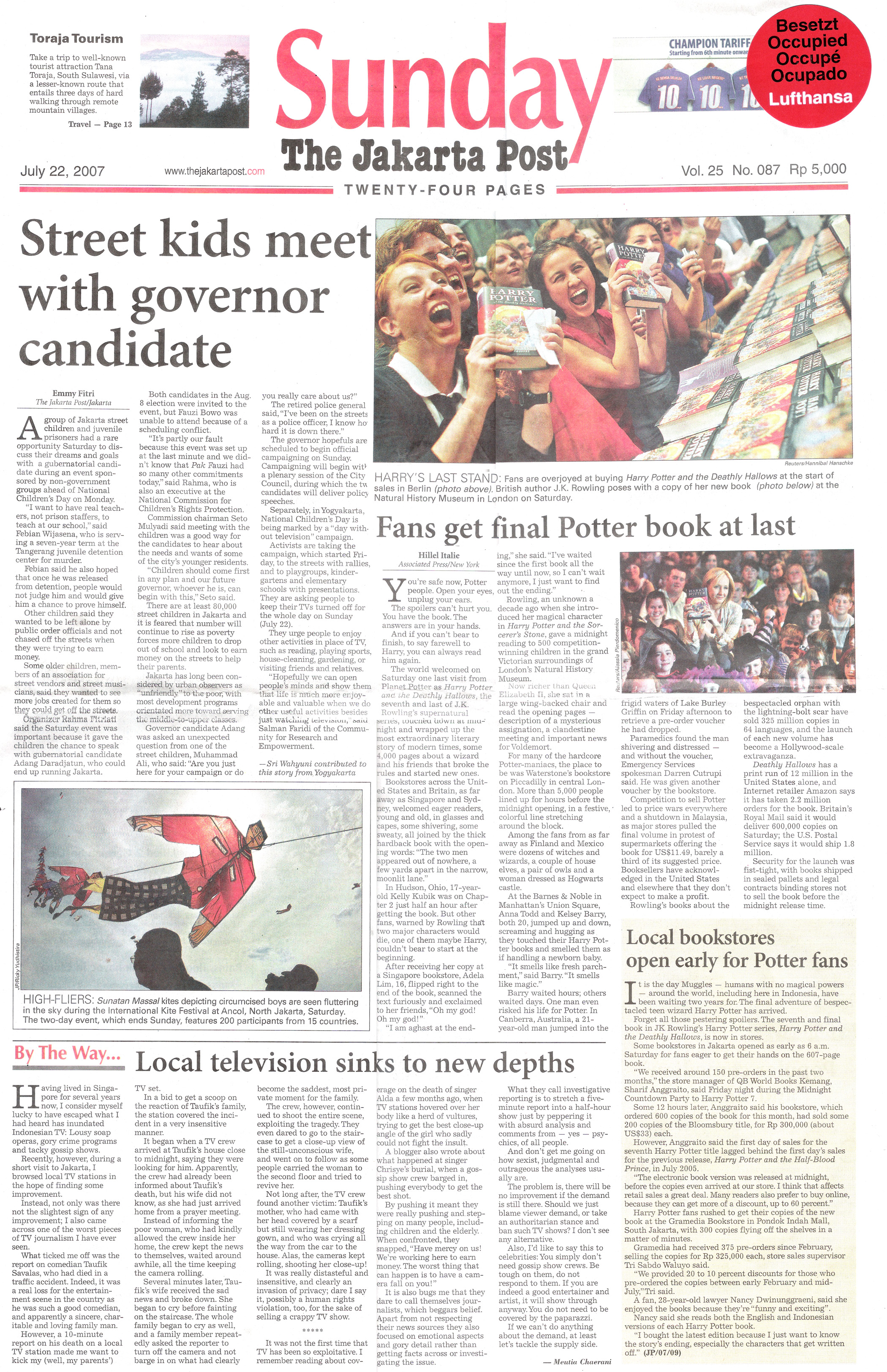
Sunday, June 15, 2008

Future Shock


These shopping plazas just keep getting bigger and bigger you know. Last week I paid a visit to the new Plaza Grande which stretches all the way from the currently under reconstruction Hotel Indonesia almost until Tanah Abang.

I felt some initial disorientation upon leaving my taxi as the building of this behemoth of a Plaza has entailed a complete transformation of the surrounding area's topography. "Jagung Tinggi!! Where the hell am I?" I thought cryptically as the Plaza loomed over me ominously.

I located one of the entrances and headed for the automatic sliding doors. As I entered, too extravagantly coiffured local ladies exited and got into a top of the range BMW. Clearly this Plaza was going to be the utmost in discerning luxury; reassuringly expensive and free of vendors selling three pairs of socks for Rp.10,000.

Inside I was soon lost within the maze of boutiques, escalators, mezzanines and 'air bridges'. The place was so huge and opulent that it seemed like some vast intergalactic space station populated by hyper rich humanoids. A retail simulation of reality blasted out of orbit and freed from the surly terrestrial bonds of affordability, sweat and dirt.

I spiralled upwards through the labyrinth of escalators, heading ever deeper into the heart of the Plaza. The upper floors seemed to push further and further into the realms of a weightless virtual reality, a future interior world in which the pleasure principle is the only social imperative and all mankind has left to do is shop and have fun.

The restaurant food court floor is an absolute fantasy land. It is draped entirely in the mellow browns and rustic hues of ethnic fabrics. I came across a mini funfair on my epic voyage as well as an indoor beach (yes really). Elsewhere, the Grande's upper floors are a postmodern, post historical mix-and-match of Elizabethan lamp stands, Roman Fountains and Greek friezes. It all seemed like some hi-tech, hedonic hologram world in which debit cards and doughnuts reign supreme.

I read recently that the city apparently plans to develop Jl. Casablanca as Jakarta's answer to Orchard Road in Singapore. A huge mall complex that will no doubt leave even the Grande in the dust, just as the Grande has left that previous plaza size record holder, Senayan City, behind.

And so Jakarta's Plaza bubble continues to grow apace, driven by a thirst for instant profits, a dearth of imagination and, these days, a reckless disregard for the impending inflation hikes and consumer crunch. Yes, the shopping mall continues to spread its deodorized tentacles throughout every vacant space in the city; these days usually with some attached luxury apartments spliced onto the side. Jakartans highest aspiration is apparently to be able to walk straight out of one's front door and into a Plaza without having to first expose oneself to the city's fetid air.

It may be that at some time in the future, all of the city's plazas will join up and be linked by various 'air walks' and travelators into one huge indoor society of petty bourgeois shoppers. The huge meta-plaza will link up with apartments, hospitals and schools to create a total life plan for the middle and upper classes whilst the underclass squats in rags over bonfires outside the Plaza's portals, roasting dead rats on sticks, left permanently out in the cold (warm?) A new generation of kids will be born inside the meta-mall and stay there for the duration of their lives.


I too began to get an uneasy sense, as I wandered around the enormous Grande, that I'd never find the exit. My whole dystopian omni-mall fantasy/nightmare was starting to remind me of H.G. Wells' The Time Machine. In Wells' seminal science-fiction novella, a man invents a time machine and travels into the earth's future. When he gets there he finds that mankind has diverged into two distinct species.

The overclass, called the Eloi, have had all of their material needs met by an advanced technology which has subjugated nature to its own designs. The Eloi live in a hollow utopia however as this amazing technology, through the meeting of all of their material needs and demands, has led to their devolution. The Eloi no longer have to strive and struggle for anything and they have thus become incurious and physically weak.

The underclass in this future are called the Morlocks. The Morlocks are cannibal and bestial, resembling human spiders. They live underground and maintain the machinery that keeps the Eloi docile and well fed. Both species are of sub-human intelligence.

I think that old HG's book can be viewed as a political allegory as much as anything and perhaps the seeds of this extreme vision are being sewn in Jakarta and in other large cities around the world. As I wandered around the Grande, gradually feeling myself pacified and mollified by the shiny lights, piped music and glittering consumer durables, I began to feel my inner Eloi struggling to emerge.

Dave... my mind is going Dave... no hang on, that was something else

Sunday, June 08, 2008

Walk the Line


The oil price spike is, of course, hurting not only this country but the entire world at the moment. This week we learned that the CEO of PT.Indonesia, Mr.SBY has, in his desperation, invested about $1 million of government money in the bogus claims made by some bloke called Joko who he ran into at his local KFC once.

The mysterious stranger's assertion that he could turn water into fuel, a process dubbed Blue Energy by the credulous Mr.Y, has oddly enough proved to be the utterly unscientific load of hokum that I think most of us could have guessed that it was from the word go. However, if Mr SBY is reading this, my mate Dave has perfected a cold fusion process in his Mandi and is quite keen to secure a bit of funding in order to retile it.

The energy crisis, global warming, spiraling food costs; the human race is waltzing ever closer to the precipice it would seem. Now more than ever it is time to green our lives and societies and reduce our carbon footprints. Jakarta's streets are jammed ever tighter with cars and the busway has turned out to be a pretty clunky and inadequate attempt at a solution. Furthermore, all that remains of the putative monorail are the slowly ossifying concrete stumps that pointlessly dot the city's main thoroughfares like so many monolithic monuments to incompetence.

It’s in this context that I’d like to say a few words about Jakarta's oft neglected pedestrians and their 100% bio-organic use of leg power. The humble pavement could be the wave of the city's future (I refuse to use the word sidewalk in this week's MM despite the Jakarta Post's institutionalized use of American English).

When I return home to see my family in London I think nothing of enjoying a 20 minute stroll to the shops or to the tube station. This is largely due to the fact that it's possible to do so without tripping over, being forced into the road to play chicken with endless motorcycles or otherwise being asphyxiated, shouted at, tapped up by primary school age beggars or scolded by flying fried rice.

Similarly, in Java's lush countryside, school kids think nothing of cycling or walking a few kilometers through beautifully verdant palm trees and paddy fields to their schools. In Jakarta's urban jungle though, attempting this every day would be seriously hazardous to one's health.

Walking on Jakarta's pavements is often like walking down a more organized city's pavements having had five bottles of Anker. This is a situation that becomes all the more hazardous if you've actually had five bottles of Anker. Keeping one eye ahead and one eye on the jagged street below requires a bit of ocular gymnastics but it's worth the effort in the end.

All of this has led to a reluctance by many to indulge in the odd bit of Jakarta pavement pounding. Such reluctance only adds to the population's general unfitness and also serves to further socially alienate rich car owners from the city's vibrant but impoverished street life. A bit of serious pedestrianisation of certain areas of town would be a positive step forward and perhaps even act as a balm on the deep wound of the city's huge class chasm.

Overpopulation is part of the problem of course. The streets here are simply teeming with people trying to earn an honest or not so honest living. So far, the city administration's only solutions to urban migration from the poor countryside have been to turn people away from bus stations as they arrive and to crack the skulls of low income city residents who hold non-Jakarta ID cards.

The city's pavements do, however, also contain many great pleasures within the boundaries of their dusty (or more often than not completely nonexistent) kerb stones. Great food is never more than a stone's throw away and the (usually) friendly "Hello Mr."s flow thick and fast if you’re a pale face. The streets are also generally safe at night and local chaps largely seem too busy squatting in the toilet position smoking cigarettes to mug you at knifepoint.

My five-minute walk from the house out to the main road for a taxi or bus is a typically Jakartan stroll. Firstly I have to negotiate the local satpam security guards who spend their lives pacing up and down the cul-de-sac outside my window. If I'm really lucky they'll be playing street badminton or pumping some hot Dangdut grooves. Then it's a quick pace up the hill avoiding swerving Bajajs and scooters. From there I plunge into one of the city's millions of alleyways where local kids subject me to the full white Negro "Mr Mr!" assault before I reach my good friend, a seemingly octogenarian fruit seller who sits all day at the front, and purchase a few slices of melon and papaya to take with me.

Finally I emerge blinking onto the cauldron of the main road and the full frontal assault of Jakarta's chaotic Brownian motion. Then I merely have to open a taxi door without knocking a motorcyclist to the ground or being knocked to the ground myself. Sharp exhalation of breath, meter running, newspaper out, shirt wringing with sweat, sorted. “Where are you going Mr?” “Nowhere Pak, nowhere at all”.

Sunday, June 01, 2008

The Dodgy Decade


There has been a lot of hand wringing and soul-searching in the media recently regarding the 10th anniversary of Mr. Soeharto being toppled and the start of the country's transition to democracy. The general consensus seems to be that Indonesia is still very much in transit. In fact I reckon it's barely left the depot and is currently stuck in traffic around 50 yards down the road surrounded by tofu and cigarette sellers.

Indonesia's 1998 revolution did indeed have a pretty hollow ring to it and seemingly left about 90% of Suharto's New Order regime still clinging on to the reins of power. Perhaps it all ended before it even started, when the students, stunned that the old man had finally fallen on his sword, accepted the incumbent vice president, nutty Professor BJ Habibie as his replacement.

Away from the Academy, at street level, the '98 rioters were somewhat less than egalitarian in their anti-New Order fury. Most of their revolutionary fervor seemed to be directed towards looting TV sets from shopping plazas and then setting fire to the ground floor whilst their comrades were on the upper floors nicking kitchenware from the food court. Boy did they get a surprise.

Another fun activity enjoyed by these visionary revolutionaries was breaking into ethnic Chinese homes and businesses and raping the womenfolk whilst chanting,"Allah Akbar." The ghost of the late Che Guevara, had it been drifting through the city on those dark days, may have had a few bones of contention to pick with this rather compromised struggle of the urban proletariat. "Seize control of the means of production... and then burn them down? Erm... Hang on a minute lads."

Looking back from a decade on at this historical flashpoint it seems pretty clear that the transition towards democracy has been painfully slow, if not actually completely static with regards to stuff like corruption and the legal system.

Indonesia's two big news stories of the past few weeks seem to suggest that much of the impetus for change has evaporated into the ether and that a fairer country is still a hell of a long way off.

The first story is that of the Ahmadiya Islamic sect and the government's moves to ban the group rather than to nail its colors firmly to the mast of modern secularism as it should do. I find it depressing that as soon as Indonesian society won its freedom from the political oppression of a tyrannical dictator, it immediately seeked to re-emasculate itself under the yoke of religious oppression and dogma.

Today, it is the Ahmadiya that suffer but I suspect that many of the country's Christians, Buddhists and Hindus are starting to sweat it a bit. "There is only one Islam," chant the Ahmadiya terrorizing extremists incorrectly. Indonesians are Sunni Muslims. I suggest these fundamentalists book flights to Iran or Iraq and see what reception their message receives from the Shia majorities over there.

The confusing constitution and the need to revise it are at the heart of the issue here. The constitution supposedly guarantees, "Freedom of religion." However, the nation's totemic Pancasila ideology only allows six official religions and also obliges citizens to believe in one God.

There are contradictions here. The Hindus of Bali have many gods whilst Buddhists and Confucians have no God at all. And of course it goes without saying that atheism is completely off the map. Where did they get this number one from? Presumably from the dominant monotheism.

The other great issue of the last month or so has been the government's decision to cut fuel subsidies and raise prices which has focused attention again on the desperate inequalities and poverty of Indonesian society. Acquaintances of mine have argued that it's the rich with their gas guzzling cars that have been the main beneficiaries of the fuel subsidies. In purely financial terms this is undoubtedly true, as is the fact that we should all cut down on our consumption before the planet boils alive. If fuel is kept at an artificially cheap price, people have no incentive to use it more sparingly.

However, things look different to the country's poor majority. A rise in fuel prices will no doubt lead to a rise in inflation. If you are on the breadline and lead a hand to mouth existence then a small rise of Rp 500 on your bus fare or your bag of beras (rice) is going to push you further towards the abyss.

There is no great tradition of helping the little man in this country but a nation a decade into democratic reforms should be able to organize something a little better than driving vans full of cash handouts into vacant football fields and letting the rabble descend pell-mell.


There's never a dull moment here though I'll concede that. Here's to another decade of fun.

Sunday, May 25, 2008

Keep On Pluggin’


Time for a shameless bit of self-promotion and a gratuitous plug this week. A sumptuous new hardback book about our fair city has just been published by Bali Purnati. It's called Jakarta, Jayakarta, Batavia and I'm in it! I contributed an essay of my usual bowel shatteringly misinformed invective to the project and can now ship a copy back to my dear mother in the UK to show her that I haven't totally urinated my life up the wall in this country.

Other contributors include Bugils group head honcho and Bule Gila author Bartele Santema, Tempo English edition editor and keen Rotarian Richard Bennett, Late Tanamur owner Ahmad Fahmy and grizzled campaigner and author of Foreign Fields for Ever: the Story of the English in Indonesia in 1945 David Jardine.

The volume's real stars are probably its photographers however. The book contains some fantastic snapshots of the city in all its finery and squalor. My favorite pictures are probably the ones that have been taken from a micro light aircraft by intrepid daredevil mental case Jez O'Hare. The shot of the skyscraping BNI building from just above its spire is breathtaking, as is the aerial shot of the Semanggi cloverleaf traffic intersection which looks surprisingly green and verdant from the sky.

The book is currently selling for Rp.300,000 which is a reasonable price for a large weighty hardback in this country. Books in Indonesia are still subject to a luxury goods tax which accounts for their relatively high price. Reading is considered a luxury it would seem which I guess says a lot about the local elite's sheep herding approach to culture and literacy but I digress.

I first got involved in the book via its publisher, Mr Leonard Lueras, a long-term Indonesian expatriate, writer, publisher and all-around culture vulture. Mr Leonard had left his exotic Pied a Terre in Bali in order to slum it in Jakarta with the likes of yours truly and research the weird and wacky world of this nation's capital. The result is a genre bending book which uniquely mixes historical perspectives with the city's contemporary, deracinated, combustion engine and cell phone culture.

My personal photographic highlights from the book include a shot of a bewildered westerner and his considerably younger local female consort up to their waists in last year's flood waters wondering what the hell their next move should be. Classic. There's also a nice photo of a motherly Ibu (tautology?) Wearing a Jilbab (Islamic headscarf) unloading a few rounds at a shooting range. Just call it psychotherapy. The book's pretty up-to-date too and includes references to Soeharto's death, the Jakarta Post 25th anniversary and newly elected city governor Fauzi Bowo and his all singing, all dancing moustache.

Writing wise, Bugils’ Bart has contributed an interesting essay on Dutch Jakarta, complete with lots of lovely orange photos. David Jardine writes on Jakarta's annual Highland gathering (alas cancelled this year due to lack of funds apparently). Richard Tempo Bennett discusses the city's rabbit warren of gangs and I myself contribute my usual upbeat mix of suicidal pessimism and cynicism into the frame to balance against Mr McBeth's slightly chirpier piece on the modern imperatives at work in this great and grubby city.

There's even a Dutch/Indonesian glossary at the back of the book that reveals the colonial origins of many Bahasa words. Karcis (ticket), Preman (gangster), Tante (aunt) and Handuk (towel), among many other definitions in the glossary, are all of Dutch origin apparently. The word Pispot is also part of the country's linguistic inheritance from the Dutch and has often been a source of mirth to Indonesians wishing to mispronounce my name. Rotten buggers.

Jakarta, Jayakarta, Batavia is currently available at the city's bookstores and is also being specially promoted at Eastern Promise Kemang for the next few weeks. Mr Leonard has turned the bar into a riot of orange and has also erected a display of the book's many fantastic photos. Buy a copy and file it in your personal rest room library today. You won't regret the investment when you're enjoying a two hour, post Satay food poisoning sit down.

Sunday, May 18, 2008

On the Cards


I found myself in a well-known chemist's (or drugstore depending on your ethnic bias) the other day stocking up on dental floss, vitamin tablets and prophylactics. Upon reaching the front of the checkout queue, the charming young lady cashier ran my items through and then asked me if I had a member's card. I replied in the negative and then pondered for a moment upon the full import of her question.

So, on our advertising fueled simulation of a planet, our endless quest for a slice of petty bourgeois exclusivity and VIP kudos means that it is now actually possible to become a member of a chemist's shop. What could this mean? Perhaps there is an exclusive members' lounge above the chemist where one can play billiards, smoke Cuban cigars and drink shot glasses of cough mixture.

Increasingly though, many stores are offering membership and exclusive offers to any Tom, Dick or Harry who walk through the door and can be stuffed to spend 10 minutes filling in an application form. Exclusive benefits that can be accrued from membership of said shops include an endless bombardment of e-mail spam trailing special offers and a wallet so bulging with useless plastic cards that you can hardly shoehorn the thing into your Levis.

If this trend continues I'll no doubt soon find myself leaning against a Kaki Lima filling in a form to become an exclusive member of Pak Djoko's Sate Ayam Club whilst he grills my sticks and enters my e-mail address into his Nokia.

Why, increasingly, do we fall for this stuff? Why are we so mesmerized by late capitalism's technological confidence trick of the bogus utopia? Why do we become members of supermarkets and covet objects of desire that we think will portend our arrival into an exclusive consumer's 'A' league? You all know what I'm talking about here. I'm talking about the type of person who says, "Oh yes, I drive a Honda Jazz Splash edition. They were made in a limited run of 1,790,000 I believe."

Why do we fall for the endless advertising propaganda that causes us to overlay the tawdriest and most mundane of production line tat with civilized society's most hallowed ideals of refinement and sophistication? Is this the spiritual vacuum we live in? A vacuum in which the ultimate symbol of communicative empowerment, the mobile phone, has ironically become, in this country at least, a status symbol capable of alienating those who can afford the latest models from those who can't; an instant badge of perceived position demarcating social class.

For me though, the most socially sinister manifestation of our upwardly mobile consumerist aspirations are the gated communities or the exclusive housing Kompleks as they are known here. In the fortress enclave of the Kompleks our sterile dreams of material gratification are buttressed a pathological fear of the plebs outside, the broader community at large and of a globe falling apart around our ears.

The Sat Pam security guards sit in their sentry boxes controlling CCTV cameras and lockable barriers and delineate Kafkaesque boundaries of social segregation. Tenants merely have to step into their gas guzzling SUVs and head to their exclusive business parks and classy shopping malls, all the while protected and cosseted from the human flotsam living a hand to mouth existence on the streets.

During a recent visit to one of these upmarket housing complexes, my taxi was stopped and was subjected to the usual cursory bomb search whilst I myself was questioned by a uniformed security man. Who had I come to see? Did I have an appointment (I didn't, which didn't really seem to help matters). I felt like I was trying to get into the Pentagon. And me! A respectable urbane columnist from the Jakarta Post! Harangued by a man in an ill fitting white shirt decorated with nonsensical epaulettes. Didn't he know who I was?! I felt like bristling with indignation at the man's impudence. If only I had enrolled at the chemist's earlier I would have had a card to have shown him.

This continuing privatization of public space fills me with despondency as it seems to play to our most selfish and snobbish instincts. A smile returned to my face however when I remembered an anecdote I once read concerning the late British comedian Peter Cook. Our man was confronted with a puffed up diner trying to get into his trendy exclusive comedy club one evening. "What do you mean you haven't got a table for me?" He barked at the Maitre D’, "Do you know who I am?" Cook, who was standing nearby at the time, made straight for the club's PA system. "This is a public announcement," he intoned over the microphone. "There appears to be a man at reception who doesn't know who he is. If anyone recognizes this man could they please contact a member of staff."

Who am I? Will anyone recognize me? Well they will once I've applied for my Indo-Maret Platinum Card. Then I will have arrived at the top table.

Monday, May 12, 2008

Metro Mad, friend of the stars


Got no column to post this week due to major limbic system damage and synaptic burn out. More toss next week. In the mean time I'd just like to say that I've received a lot of comments recently, which makes a change, nice or otherwise. My most prized being from Newsreader wunderkind Desi Anwar:

Dear Mr Pitchforth,

For a longtime I thought your name was Mr Pitchfork so please forgive me if my reaction to being introduced to you was unbecomingly underwhelming. However, having digested the information, together with the Ritz' exceptionally smooth Cabernet Sauvignon, that you were none other than the great Mr Blogger himself (and suspecting that somehow my name would be a victim of your deadly quill) I soon realized the dangers of rubbing shoulders with such illustrious man about town as yourself, especially as I was trying to downplay my reputation as deadly assassin. (Being a journalist is already a dangerous profession. Trust me I have no desire to expand my CV to other more dangerous professions). Having said that I bow in deference to your blog ranking and am ashamed to say that in that respect I certainly cannot hold a candle to you. By the way, should you by any chance require anybody important 'taken out' I am more than happy to talk business... Regards, Desi Anwar


Whoops!! Sorry Miss Anwar. It was a lovely party and I enjoyed being introduced to famous people such as your good self. Hopefully you've just boosted me up to #46 in the blog war ratings there. Actually there are a few people who could do with the poison tipped umbrella treatment but we'll have to leave that for another time...

To be frank I was very surprised to receive your comments. Nobody's heard of me. Even my Mum has to be reminded who I am.

Sunday, May 04, 2008

Party Like it’s Ya Birthday


As regular readers could hardly have failed to notice, the Jakarta Post recently celebrated 25 years in the newspaper business. Unlike regular riffraff though, I was actually extended an invite to the paper's anniversary party which was held in the very posh and swanky ballroom of the Ritz Carlton hotel last week. Now as I fire off my column by e-mail every week I don't really know anyone who works full-time at the paper. Consequently, this was my big chance to meet my fellow JP-ers. So last Friday evening I donned my cleanest and most crisply starched underwear and bagged a Bluebird down to the Ritz.

When I arrived in the huge function room I could see that the city's bourgeois movers and shakers had turned out in force for the birthday celebrations. There were about a thousand people present, all dressed up to the nines and all schmoozing like crazy. I made a beeline for the free wine that was being ladled out at the rear bar and had a quick scan around the hall.

TV Newsreader and Jakarta Post Weekender columnist Dalton Tananaka was onstage MC-ing and various dignitaries were swanning around grinning from ear to ear. I was briefly introduced to the famous TV reporter and not Ramos Horta assassination co-conspirator Desi Anwar. I also met feminist author and fellow Jakarta Post columnist Julia Suryakusuma as well as respected Southeast Asian journalist John McBeth. All three seemed frankly under-whelmed to meet my good self, Indonesia's 47th most popular blogger and columnist but that's fair enough I suppose. In any case, I was quite content to wander around nursing several glasses of vino.

By about 11, most of the posh people had already pushed off home and I was left chatting with the real JP staffers who invited me on to the post-party party that was being held at the Post's brand spanking new offices in Palmerah.

On the way out of the Ritz Carlton, we were all given a goodie bag which very generously contained a copy of the new Jakarta Post book The Voice of Reason. This meaty hardback is well worth tracking down and is basically an anthology of the Post's editorials over the years. Reading the whole thing from cover to cover in one go would probably give you terrible indigestion. It’s a great book to dip into though and the volume contains an index at the back, making it an invaluable reference source.

Over at the swanky new JP building the joint was most certainly jumping. The young reporters and copy editors had set up a disco and were drinking and dancing to all that toe tapping pop and roll music so beloved of young people. It fare well reminded me of my undergraduate days I can tell you, especially when, after imbibing a veritable distillery of Bourbon, a young lady attempted to maneuver me into the stairwell to discuss her ex-boyfriend's infidelity. ahem.

The Jakarta Post though. What to say after 25 years? I think I'd assert that its heart has always been in the right place. Even during the Soeharto era, when political criticism had to be muted, its stories were often couched in euphemistic terms which allowed one to read between the lines to an extent.

I'm sure that many of you saw last week's reprinted facsimile of the first ever edition of the Jakarta Post from 1983. The international headlines were very different back then but the local news seemed all-too-familiar; tales of corruption and religious fundamentalism were the leading stories. How little things change ay?

Admittedly, I myself work for the JP in a limited capacity, however I assure you that I'm not receiving any bonus for this gratuitous plug (although if anyone in charge is actually reading this...) The Post has though, in all truth, been my window on local life during the decade plus that I've lived here. Perhaps porthole would be a more apt metaphor here however as Indonesia often seems far adrift of dry land. It hasn't always been plain sailing though of course; The Post's quotations of figures and conversions of Rupiah into US Dollars in news stories have, in the past, displayed a certain level of innumeracy. Either that or they’re indicative of a dearth of pocket calculators in the office.

In general though, the Post has always stood resolutely on the side of truth and justice and has exhibited a great deal more independence than many Western corporate controlled media mouthpieces. It has also seen off challenges from the long gone English-language rival, The Indonesian Observer and more recently from the Bakrie controlled rag The Point. (Is it still being printed by the way? I haven't seen it for weeks). The Point recently dispensed with all of their native speaker copy editors which, if you read last week's Metro Mad, you'll understand is a hazardous exercise.

The Post though remains my porthole on Indonesia and I religiously read its stories and editorials every day. I have to confess however that I usually turn to the letters page first. I love to see what apoplectic nut bag has written in to vent their spleen on any given morning. The new SMS text message mini letters are a worthy innovation but the old adage about giving someone enough rope to hang themselves usually sways me towards the longer rants.

Long may the JP survive and continue to pay me.